
The Sunday sun was barely up, but the two apartments were already awake. In the small studio, one person shuffled around in socks, picking up a coffee mug, shaking out the blanket, opening the window. In the big suburban house across town, another person was doing the same… sort of. Except their “quick tidy” meant walking up and down the stairs three times, passing three half-finished rooms, and losing the vacuum hose somewhere between the hallway and the guest bedroom.
Cleaning looks like the same chore on paper. Yet the feeling in a 35 m² nest has almost nothing to do with the feeling in a 250 m² family house.
The mop is the same. The brain experience is not.
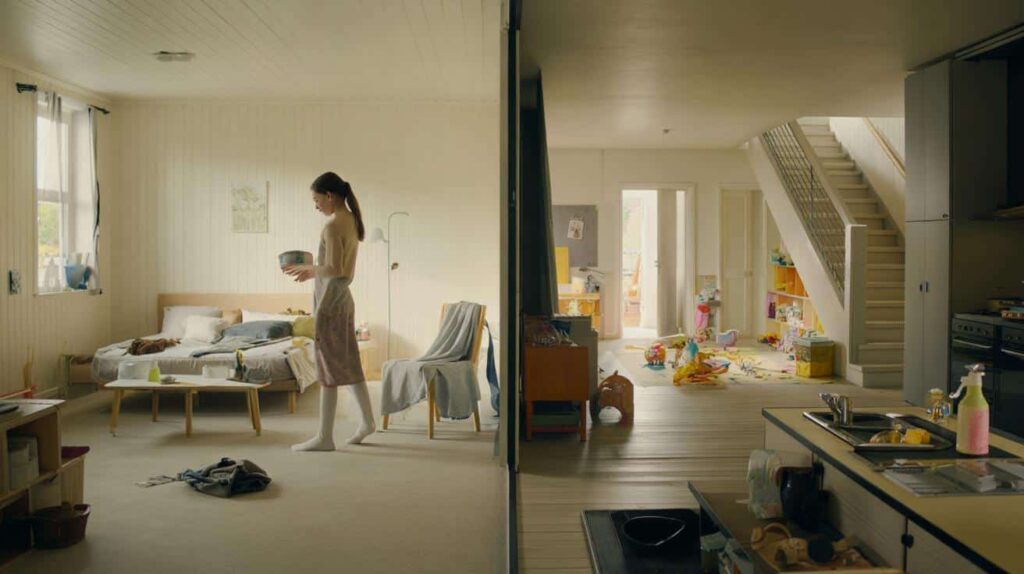
Why the same mess hits differently in 35 m² vs 250 m²
Walk into a small home after a long workday and one dirty plate can feel like a crime scene. The bed is in your eyeline, the kitchen is within arm’s reach, the pile of laundry is basically sitting on your soul. In a small space, every object has a louder voice.
You can’t ignore the crumbs on the counter, because they share the same air as your laptop, your dinner, and your sleep.
A small home makes mess feel personal, almost intimate.

Step into a large house and the story flips. The same amount of mess spreads out, dissolves into corridors and corners. Dishes stay in the kitchen. Toys gather in the playroom. The upstairs bathroom can quietly collect dust for weeks without anyone really noticing.
One woman I interviewed described her 200 m² house as “an endless series of small, half-dirty zones”. No single room was a disaster, yet she always felt behind.
In a way, big homes hide the mess. And that’s not always a blessing.

What changes between small and large homes is not just the square meters. It’s the psychological weight of what you see in one glance. In a studio, your brain gets the full picture immediately: bed, table, sink, floor. Tidy or not, it’s all on display.
In a big house, your brain gets fragments: this hallway is fine, the living room is okay, the kids’ room is chaos, the garage is a mystery. The mental load stretches with the floor plan.
Cleaning becomes less about one clear task and more about a shifting map you never quite finish coloring in.

How to clean when every square meter stares back at you
In a small home, the most powerful cleaning tool isn’t a fancy vacuum. It’s strict, almost ruthless, routines. Not long ones, just tight ones.
Think “10-minute reset” instead of “Saturday deep clean”. One loop for the whole space: dishes in the sink, clear the table, wipe counters, shake out one rug, quick bathroom check. Done.
Because you see everything at once, it helps to act in loops, not rooms.
The trap in tiny spaces is waiting for the mythical “big clean” day. That day rarely comes, or when it does, you lose half of it scrubbing a shower you’ve been side-eyeing for three weeks. Then the mess is back by Tuesday and resentment moves in for free.
We’ve all been there, that moment when a single chair covered in clothes suddenly represents all the ways life feels crowded.
The gentler way is to slice cleaning into tiny, repeatable rituals that almost run on muscle memory.
*“The smaller the space, the faster it swings between ‘cozy’ and ‘overwhelming’,”* a friend in a 28 m² apartment told me. “So I stopped trying to be perfect and just guard three things: clear surfaces, empty sink at night, floor visible.”

- Pick one visual rule (for example: nothing lives on the floor).
- Attach it to a habit (after brushing teeth, two-minute bathroom reset).
- Keep supplies tiny and nearby (mini spray, one cloth per room).
- Accept “good enough” on weekdays.
- Let one corner be wild if it saves the rest.
When space multiplies, so does the cleaning strategy
In a large home, the problem usually isn’t scrubbing. It’s scope. You can mop for an hour and still feel like nothing moved. The win is too spread out to feel satisfying.
One simple shift changes the emotional math: stop cleaning the house, start cleaning “zones”. Kitchen only. Bathrooms only. Downstairs only.
Big homes respond better to territory than perfection.
A family in a five-bedroom house shared their trick with me. Each day has a “hero zone”: Monday is kitchen, Tuesday is hallway and entry, Wednesday is bathrooms, and so on. They still do micro-tasks daily, like wiping the table or loading the dishwasher, but the deeper effort rotates.
Nothing is spotless all the time, but nothing decays into chaos either.
Let’s be honest: nobody really does this every single day. Some weeks get skipped. And still, the structure holds.
The emotional trap in big houses is guilt. You have the space you dreamed of, yet you feel constantly behind. There’s always a guest room that could be better, a basement you pretend doesn’t exist. The house starts to feel like a to-do list printed in bricks.
The plain truth is: **large homes are not meant to be fully “done” at once**. They are rotating projects, lived in by real humans with finite energy.
Once you stop expecting hotel-level readiness, every cleaned staircase suddenly counts for more.
The secret difference: who owns the mess you don’t see?
Here’s where small and large homes secretly meet: both are asking the same question. Who owns the mess? Who carries the mental load of noticing, planning, doing?
In a tiny flat, one person often feels they are the “guardian of order” because every sock out of place instantly affects the whole vibe. Their brain is always on alert.
In a large home, that guardian role can stretch so far it becomes almost invisible, yet twice as exhausting.
Some couples silently fall into a pattern where one person “sees” the dirt and the other mostly reacts when asked. In small spaces, that can explode faster, because the visual impact is immediate. In big houses, it can simmer for years under a clean-enough living room.
Sharing the load starts with sharing the map. Literally. Walk through the house together and list the invisible jobs: changing sheets, descaling the shower, wiping baseboards, dealing with the entryway shoes.
You can’t redistribute what nobody has named.
- How do I stop feeling like the live-in cleaner?Start by separating “I care more about this” from “I do everything”. Say it out loud. Then trade one whole zone each, not tiny bits. Ownership feels lighter than nagging.
- Is a big home always harder to clean than a small one?Not always. A well-planned large house with storage, good flooring, and clear zones can be easier than a cluttered studio. The layout and habits matter more than the square meters.
- Why does my studio feel dirty even when I clean a lot?Because every object is in view and there’s almost no “visual rest”. Try decluttering surfaces before cleaning more. Fewer things, same elbow grease, big impact.
- Should I hire help for a big house?If your budget allows, even a cleaning session once a month can reset the baseline. You still do the dailies, but the heavy stuff stops building into shame.
- How often should I really deep clean?Forget the ideal calendar. Look at friction points: when the shower grosses you out, when the kitchen smells, when the floor feels gritty. Deep clean those first. Frequency will adjust to your real life.
| Key point | Detail | Value for the reader |
|---|---|---|
| Visual impact | Small homes show everything at once, big homes spread mess out | Helps you understand why your space feels “dirty” or “never finished” |
| Strategy shift | Loops for small spaces, zones for large homes | Gives you a realistic way to clean without burning out |
| Mental load | Noticing and planning can be heavier than the scrubbing | Opens the door to sharing tasks and dropping guilt |
FAQ:
- Why does a small mess feel so much bigger in my tiny apartment?Because your brain takes in the whole place in one glance. There’s no “spare room” for the mess to hide, so that one chair of clothes or full sink hijacks your entire mental picture of home.
- How can I keep a small home from feeling constantly cluttered?Start with one rule: every item has a home. Then protect three daily habits only: clear surfaces, quick floor scan, dishes reset. Beyond that, let go a little.
- What’s the first thing to change in a large house that’s overwhelming to clean?Choose a hero zone and stick with it for a month. For example, own the kitchen fully. Once that feels under control, add a second zone instead of trying to fix everything at once.
- Do I need more cleaning products for a bigger house?Not really. You need smarter placement, not more stuff. One caddy per floor with the same basics usually beats a crowded cupboard nobody wants to dig through.
- How do I get my family to help, whatever the size of our home?Give people whole jobs, not random tasks. “You’re in charge of the entryway this week” is clearer than “Can you help more?”. Ownership turns chores into territory, which the brain handles better.
