
I’ll admit it when it comes to exercise advice for my parents and close family, I can be a bit persistent. There are five key strength exercises I strongly encourage my loved ones to do to stay mobile, strong, and independent as they age. You don’t need a fully equipped gym to perform these movements. However, investing in a solid pair of adjustable dumbbells or a durable set of kettlebells is a smart idea. As your strength improves, increasing resistance ensures your muscles continue to adapt. You can always adjust the load, reps, and sets to keep each exercise challenging and effective. If you’re ready to begin, here’s a breakdown of the exercises and why they matter.
1. Tip-Toe Farmer’s Walk
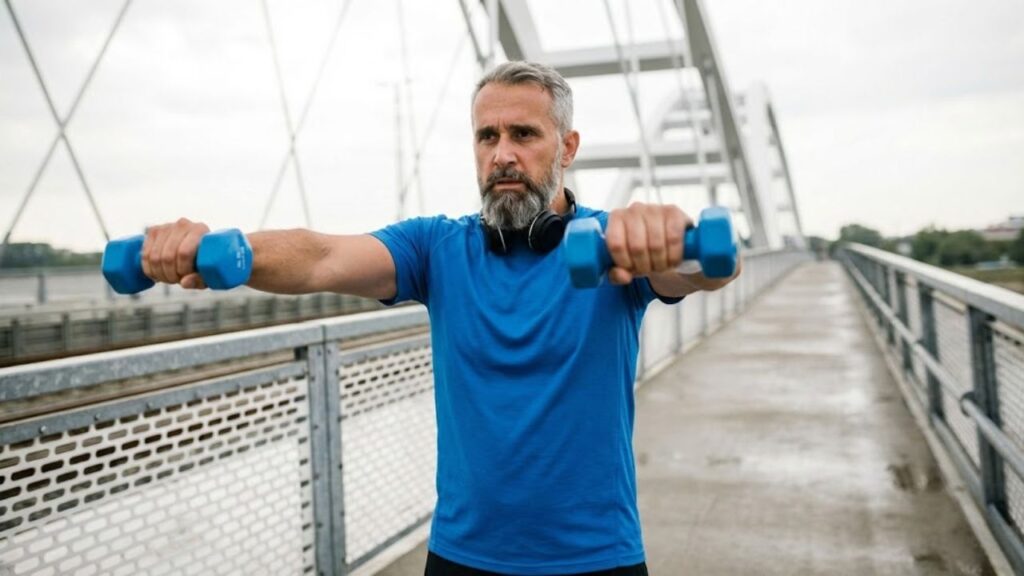
Your calf muscles play a vital role in lower-body stability and everyday movement like walking and running. Unlike traditional calf raises, the tip-toe farmer’s walk requires you to stay in plantar flexion — meaning you remain on the balls of your feet the entire time. I recommend holding lighter weights for this exercise. Balance and coordination become more challenging on your toes, activating your core and smaller stabilising muscles throughout the body. Hold a weight in each hand, stand tall, rise onto the balls of your feet, and walk forward at a controlled pace. If needed, alternate between flat-foot walking and tip-toe walking at first, gradually progressing to staying fully elevated as confidence builds.

2. Prisoner Squats
Prisoner squats demand more from your upper body while testing mobility in your hips, knees, ankles, and upper back. They’re especially helpful if you notice yourself leaning forward during squats, which often signals limited mobility. To perform this movement, lightly place your hands behind your head and squat down while keeping your chest lifted. Sink your weight into your heels and lower your hips as deeply as your mobility allows. To make things more interesting, I sometimes add a hip hinge at the bottom of the squat. From the lowest position, push your hips back and hinge forward slightly, bringing your chest closer to parallel with the floor before returning upright and standing tall. This variation increases hamstring engagement.

3. Split Squats
Split squats are an excellent alternative for anyone who finds lunges difficult. Because your feet remain planted, balance is easier to manage while still delivering serious lower-body benefits. Start in a split stance and slowly lower your back knee toward the floor, then drive through your front leg to stand. Once you’re comfortable, elevating the back foot increases the challenge and places more emphasis on the glutes. I often ask my dad to hold dumbbells during this exercise. Surprisingly, added weight can improve balance while increasing muscle engagement. Focus on slow, controlled lowering known as eccentric loading for three to four seconds, followed by a strong upward drive. This technique builds strength efficiently. A slight forward lean, while keeping your spine neutral, increases glute activation.
4. Pike Push-Ups
Pike push-ups load your shoulders and triceps vertically, similar to an overhead press but using bodyweight. They also challenge shoulder mobility and hamstring flexibility. Begin in a downward dog position. Walk your hands and feet slightly closer together, keeping your hips high. Shift your weight forward and lower the crown of your head toward the floor just ahead of your hands, then press back up. This isn’t a traditional push-up aim to stay as upright as possible to maximise shoulder involvement.

5. Overhead Squats
Overhead squats demand full-body coordination, testing upper-body strength, thoracic mobility, and squat depth all at once. The goal is to keep your arms locked overhead, close to your ears, while maintaining an upright torso. Start with bodyweight or light resistance. I often have people hold a weight plate with both hands. For an added challenge, try holding a dumbbell in just one hand to increase stability demands on each side. As you squat, distribute your weight evenly through your feet using a tripod position — heels, big toes, and little toes all pressing into the ground. Be mindful of your knees collapsing inward or your chest tipping forward. Over time, aim to sink deeper while maintaining control. A helpful mental cue is to imagine balancing a drink overhead — steady, controlled, and spill-free.

Final Thought
Strength training doesn’t need to be complicated to be effective. These five exercises build resilience, balance, and confidence — qualities that matter far more than aesthetics as the years go by. Staying strong is one of the greatest gifts you can give your future self.
