
The office was almost silent, except for the soft hum of the air conditioner and the low murmur of a Zoom call someone had forgotten to mute. On one screen, a guy in his thirties moved endless cells in Excel. On another, a brand-new AI tool did the same job in seconds, without blinking, without sighing, without coffee.
He watched the results appear instantly and laughed, a little nervously. “So… what am I here for, exactly?”

That question is suddenly everywhere.

# The Changing Face of Work

Workers across many fields are experiencing the same shift. Coders & translators face it. Graphic designers and call center employees see it too. We are all moving toward a future where machines handle tasks without needing breaks or benefits. These machines never complain and never demand higher pay. Elon Musk believes everyone will eventually receive what he calls a universal high income. Bill Gates suggests we need to tax robots and completely rethink how we view work itself.
A physicist who won the Nobel Prize now says they could be correct.
The Nobel physicist who backs Musk and Gates
Giorgio Parisi is not a YouTuber chasing clicks. He’s a Nobel Prize–winning physicist, awarded in 2021 for his work on complex systems – those messy, unpredictable things like weather patterns, stock markets, or… human societies under technological shock.
When he looks at AI, he doesn’t see just clever chatbots. He sees a system reshaping how value is created, distributed, and lived.
His verdict is unsettling and oddly hopeful at the same time.
More prosperity, more free time, fewer traditional jobs.
Parisi has been blunt in interviews: if AI keeps advancing at this speed, many cognitive jobs could vanish as quickly as physical ones did during past industrial revolutions. The difference now is scale. White-collar work, once seen as safe, is suddenly exposed.
Imagine a logistics company that previously needed 1000 planners on staff. After implementing AI technology the company can now manage worldwide shipping routes and predict potential delays while updating pricing instantly with only 50 employees monitoring the system. The business expands significantly. Revenue increases substantially. Output per worker rises dramatically. The company becomes more efficient but the workforce shrinks by 95 percent. Those 950 former planners need to find new employment elsewhere. Some will transition into different roles but many will struggle to find comparable positions. The technology creates value for shareholders and customers through lower costs and faster service. However it eliminates jobs faster than new opportunities emerge in other sectors. This pattern appears across multiple industries. AI systems handle customer service inquiries that previously required call center staff. Algorithms write basic news articles and financial reports that junior journalists once produced. Software reviews legal documents more quickly than paralegals. Machine learning models analyze medical images with accuracy that matches or exceeds human radiologists. Each advancement makes specific companies more productive & profitable. The economy generates more output with fewer workers. But this creates a fundamental challenge. When productivity gains come primarily from automation rather than human workers doing more the benefits concentrate among business owners and highly skilled employees who manage the systems. Meanwhile displaced workers face declining wages and fewer opportunities. The standard economic argument suggests that technology always creates more jobs than it destroys over time. Historical precedent supports this view. The industrial revolution eliminated many agricultural jobs but created factory work. Computers removed typing pools but generated entire industries around software & information technology. However the current wave of AI differs in important ways. Previous technological shifts typically automated physical tasks or routine cognitive work while creating demand for human judgment and creativity. AI now performs many cognitive tasks that previously seemed uniquely human including pattern recognition & decision making under uncertainty. The technology improves rapidly and scales globally almost instantly once developed. This means the adjustment period may be shorter and more disruptive than previous transitions. Workers have less time to retrain and fewer obvious alternative careers. Geographic communities built around specific industries face concentrated economic damage. The social safety net in many countries was designed for temporary unemployment between similar jobs rather than permanent displacement requiring complete career changes. Some economists propose solutions like universal basic income or expanded social programs funded by taxes on AI productivity gains. Others suggest investing heavily in education and retraining programs. Some advocate for policies that slow AI adoption to allow smoother workforce transitions. Each approach involves tradeoffs between economic efficiency and social stability. The logistics company with 50 employees instead of 1000 represents genuine economic progress by conventional measures. It delivers better service at lower cost. But progress creates winners and losers. Without deliberate policy choices the gains flow primarily to capital owners while workers bear the costs of adjustment. The challenge involves capturing the benefits of AI productivity while ensuring broad prosperity rather than concentrated wealth & widespread economic insecurity.
➡️ This creamy dinner is the kind you come back to quietly
➡️ Government orders mandatory digital IDs for all citizens starting next year, privacy advocates warn of a surveillance nightmare
➡️ “I cook this oven meal when I want everything done at the same time”
➡️ Official and confirmed: heavy snow is set to begin late tonight, with alerts warning of major disruptions, dangerous conditions, and widespread travel chaos
Gastrointestinal researchers are pointing to a growing agreement that specific fruits might affect how the gut moves through biochemical pathways that were not fully appreciated before. Scientists studying digestive health now recognize that certain fruits contain compounds that can change the speed and pattern of intestinal contractions. These natural substances work through chemical processes in the body that researchers had previously overlooked or considered less important. The new understanding suggests that fruits do more than simply provide fiber for digestive health. They also deliver active molecules that interact with the gut in complex ways. These interactions can either speed up or slow down the movement of food through the digestive system. This developing scientific consensus represents a shift in how experts view the relationship between fruit consumption and digestive function. Rather than focusing only on the mechanical effects of dietary fiber researchers now examine the broader biochemical impact of fruit components on gut activity.
# This hearty soup recipe works perfectly when the weather turns cold
When temperatures drop and winter winds start to blow nothing beats a warm bowl of homemade soup. This recipe delivers exactly what you need on those chilly days when you want something filling and comforting. The beauty of this soup lies in its simplicity. You don’t need fancy ingredients or complicated cooking techniques to create something truly satisfying. Just gather some basic vegetables & pantry staples, and you’re ready to start cooking. Start by chopping your vegetables into bite-sized pieces. The key is to cut everything roughly the same size so it cooks evenly. Heat some oil in a large pot and add your onions first. Let them soften for a few minutes before adding garlic. This creates a flavorful base that makes the whole soup taste better. Next, add your other vegetables to the pot. Carrots and celery work wonderfully here, but you can use whatever you have on hand. Stir everything together & let the vegetables cook for about five minutes. This step helps develop deeper flavors in your soup. Pour in your broth and bring everything to a boil. Then reduce the heat and let it simmer gently. The longer it cooks the more the flavors blend together. Most soups benefit from at least thirty minutes of simmering time. Season your soup with salt and pepper to taste. You can also add herbs like thyme or bay leaves for extra flavor. Some people like to add a splash of cream at the end for richness, but this is completely optional. This soup keeps well in the refrigerator for several days. In fact, many people think it tastes even better the next day after the flavors have had more time to develop. You can also freeze portions for quick meals later. Serve your soup with crusty bread or crackers on the side. A simple green salad makes a nice accompaniment if you want to round out the meal. This recipe easily feeds a family and provides leftovers for lunch the next day.
Thousands of passengers are stuck at airports throughout the United States after Delta, American JetBlue, Spirit and other airlines canceled 470 flights and delayed almost 5,000 more. The disruptions have severely affected major airport hubs from Atlanta to Los Angeles.
➡️ These zodiac signs are destined for major prosperity in 2026, according to astrological forecasts
But on payday, 950 salaries are missing from the story.
Parisi explains that when machines take over jobs from people there are only two main ways society can react. The benefits can remain with the wealthy few which leads to major inequality & anger. Alternatively we can change the system to distribute the wealth created by automation among everyone.
That’s where Musk’s idea of a *“universal high income”* and Gates’s idea of a **“robot tax”** come in. Both are crude labels for the same basic question.
If AI does the work, who gets the paycheck – and what does everyone else do all day?
If the machines work, what do we actually do?
One concrete path Parisi points to is simple on paper and radical in practice: separate income from jobs. Let AI and robots handle a growing share of production. Then channel a slice of that value back to humans as a guaranteed baseline income or heavily subsidized services.
It’s the same logic as public roads or public schools, but applied to the AI era.
You don’t “earn” the right to be on the internet by digging fiber cables yourself. You benefit from an infrastructure that everyone funds together.
# Now imagine an economy where basic living standards work the same way. Think about what would happen if an economy operated under the same principles when it comes to providing basic living standards for everyone. Picture a system where the fundamental necessities that people need to survive & maintain a decent quality of life followed this identical approach. Consider how different things would be if the economy treated essential requirements for daily living using these same methods. Envision an economic structure where the baseline conditions that determine how people live their everyday lives functioned according to these very principles. What if the way society distributed & managed the basic resources needed for a reasonable standard of living mirrored this exact framework? Imagine if the economic mechanisms that control access to fundamental living requirements operated in this particular manner. Think about a scenario where the systems responsible for ensuring people have their basic needs met worked along these same lines. Consider an economy structured so that the essential elements of a decent life for ordinary people followed this same pattern. Picture how society would function if the distribution of basic necessities and the maintenance of minimum living conditions adhered to this approach. What would it look like if the economic foundations that support everyday living standards for the general population operated under these identical rules? Imagine the implications of having an economy where the basic framework for human welfare and subsistence worked in exactly this way.

We’ve already glimpsed a small-scale version of this during the pandemic. Governments around the world flooded households with cash and subsidies when work paused. People didn’t stop living because offices and shops were closed. The money wasn’t perfect, the policies were messy, but they kept millions afloat.
Parisi’s point is that AI could create the productivity to fund something like that permanently, without a crisis. Think of a world where **40% of jobs vanish** over two decades, yet GDP keeps climbing because machines pick up the slack.
That’s both a nightmare and a promise, depending on what we do with the gains.
From a physicist’s angle, societies behave like complex systems under stress. They can adapt smoothly or crack. If millions lose their jobs and watch AI drive stock prices higher while their rent climbs, the system starts to wobble. You don’t need a PhD to predict the anger.
A calmer scenario looks different. Working hours shrink. Part-time becomes the norm. New roles emerge around care, creativity, education, climate resilience, local culture – areas where humans still matter deeply.
The hardest part is making the change. Nobody can give you exact instructions for moving from a life where your job defines who you are to a life where how you spend your time matters most. The truth is that this shift requires you to figure things out yourself. There is no guidebook that tells you precisely what to do at each stage. You have to learn through experience & adjust as you go. Most people spend years building their identity around their career. When you work somewhere for a long time your job title becomes part of how you see yourself. Your coworkers become your social circle. Your daily routine revolves around work schedules & deadlines. Breaking away from that pattern feels uncomfortable because you lose the structure that organized your entire life. Without that framework you need to create new ways to measure your worth and spend your days. The challenge is that society reinforces the connection between work and identity. People ask what you do for a living within minutes of meeting you. Your income level often determines where you live and who you socialize with. Status comes from job titles and professional achievements. Switching to a mindset where time becomes your priority means rejecting many of these social expectations. It means deciding that having control over your schedule matters more than impressing others with your career. It means valuing experiences & relationships over climbing the corporate ladder. This transition does not happen overnight. It takes deliberate effort to change how you think about work and life. You need to experiment with different approaches until you find what works for you.
Preparing yourself for a world with more free time and fewer jobs
One practical move in this in-between decade is to stop treating your job title as your whole story. Parisi, Musk, and Gates might disagree on solutions, yet they all hint at the same personal shift: focus less on “What do I do at work?” and more on “What do I know how to do, beyond this role?”
Take a blank page and write down every skill you use during a week. Do not just write general job titles like project manager or accountant. Instead focus on specific abilities such as calming angry clients or writing clear emails. Include things like spotting patterns in data or teaching colleagues how to use a tool. Add skills like organizing chaotic information or solving unexpected problems. Most people underestimate how many skills they actually use. You might think you only have a few core competencies but the reality is different. When you track your activities for several days you will discover dozens of small but valuable skills. These are the abilities that make you effective at your job even if they never appear on your resume. Write down everything without filtering or judging what seems important. The skill you use to defuse a tense meeting matters just as much as your technical expertise. The way you explain complex topics in simple terms is valuable. Your ability to prioritize tasks when everything feels urgent is a real skill that others struggle with. This exercise reveals your actual value in the workplace. It shows you what you bring to your team beyond your official job description. Many of these skills transfer across industries and roles. They form the foundation of your professional identity and give you options when you consider career changes. Keep this list somewhere accessible and update it regularly. Review it before performance evaluations or when updating your resume. Use it to recognize your own growth and to identify areas where you want to develop further. This simple practice helps you see yourself more clearly and communicate your value to others more effectively.
That messy list is your real portfolio.
AI will nibble away at parts of it. Other parts will become more precious.
A second move is psychological. Many people secretly dread the idea of “too much free time.” It sounds great when you’re buried in deadlines. It feels different when your calendar is suddenly empty because a tool replaced half your tasks.
We’ve all been there, that moment when the workload drops and instead of feeling relieved, you feel weirdly… useless.
Be gentle with that reaction. Gates has warned for years that societies still judge people harshly if they “don’t work,” even if technology has made their labor unnecessary. Musk talks about people choosing “meaningful” work instead of necessary work.
The mental shift from “I must justify my existence” to “I’m allowed to exist, then choose my contribution” won’t happen overnight.
Parisi explained his view in a recent commentary by saying that the real problem is not about people having no work available. The actual concern is whether society will be structured in a way that allows everyone to have the financial means to pursue activities and maintain their livelihood.
- Watch AI in your own job
Notice what’s already automated: reports, emails, designs, customer replies. Ask: if this got 10x better, what would my day look like? - Build “human-only” muscles
Leaning into empathy, critical thinking, negotiation, mentoring, deep craft. These are harder to outsource fully to machines. - Experiment with micro-freedom
If AI saves you 30 minutes a day, don’t instantly fill it with extra tasks. Test what it feels like to leave a bit of empty space. - Talk about money, not just meaning
Future “free time” is only interesting if housing, healthcare, food, and energy don’t crush you. Follow local debates on basic income, robot taxes, or AI levies. - Let your plans be flexible
*This era might reward people who are less attached to a single career path and more attached to learning, communities, and projects.*
What if Musk, Gates and Parisi are all right – and we’re not ready?
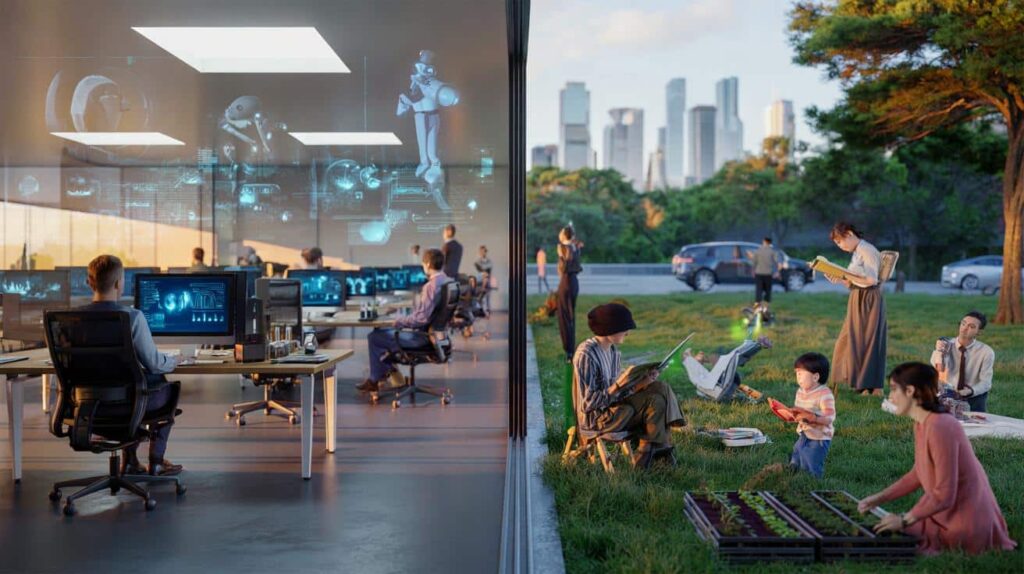
Picture a Tuesday morning a decade into the future. At 8 a.m. cities feel quieter because half of all workers no longer travel to an office. Artificial intelligence now manages shipping & delivery systems. It answers customer questions and writes basic computer code. It organizes calendars & creates standard legal documents. The changes reshape how people spend their days. Many professionals work from home or choose flexible schedules. The morning rush hour that once clogged highways has diminished significantly. Public transportation runs less frequently during traditional peak times. This shift affects more than just traffic patterns. Office buildings in downtown areas sit partially empty. Some have converted to residential apartments or mixed-use spaces. Coffee shops near former business districts serve different customers now. Instead of hurried workers grabbing drinks before meetings they see freelancers & remote employees settling in for longer stays. The technology handling these tasks has become remarkably capable. AI systems process insurance claims & generate financial reports. They draft contracts and review documents for errors. Customer service chatbots resolve most common problems without human intervention. Software writes and tests code for routine applications. Workers displaced from these roles have moved into different positions. Some retrain for jobs that require human creativity and emotional intelligence. Others find work maintaining and improving the AI systems themselves. The job market looks fundamentally different than it did ten years earlier. This Tuesday morning represents a quiet revolution in how society functions. The changes happened gradually but their cumulative effect is profound.
You start your day not by asking, “What does my boss need?” but “What do I choose to work on?” Some people log into part-time gigs that still require a human touch. Others coach, create, study, care for children or elders, restore ecosystems, or build local projects that never fit neatly into a corporate org chart.
This isn’t a utopia; it’s a possible branch of the future tree.
Another branch takes a darker turn. The same tools exist and the same robots hum away in warehouses & data centers. The productivity gains are real but the social contract never catches up. A small group of people owns the technology and takes the profits. Everyone else fights for the last shrinking human jobs. People feel guilty if they rest because rest gets framed as laziness instead of progress.
That is the critical choice that Parisi Musk and Gates are each pointing toward in their own way. They do not agree on the solutions & some of their predictions might be completely wrong.
The experts agree on one difficult prediction. The jobs we have today will not stay the same.
What remains is our time. The hours from when we wake up until we go to sleep will still exist and need to be filled with something.
The way you use your time in the future will not be determined only by artificial intelligence. Your choices about scrolling through social media or volunteering or working on personal projects or caring for family members will depend on many other factors. Government policies will play a role. Cultural values will matter. The decisions we make as a society about what we allow and what we reject will shape these outcomes.
Let’s be honest: nobody really rewrites their life in a single weekend. But this slow and awkward rewriting has already started. It happens in the office with the AI spreadsheet and in the factory with the robot arm.

The real issue is not whether machines will replace our jobs anymore. What matters more is whether we will know how to use our free time when machines do the work for us & whether we will have enough money to live on.
| Key point | Detail | Value for the reader |
|---|---|---|
| Nobel-level warning | Physicist Giorgio Parisi backs Musk and Gates in predicting more free time but fewer traditional jobs as AI scales | Signals that this isn’t just tech hype, but a structural shift worth preparing for |
| Income may detach from jobs | Ideas like universal income, robot taxes, and shared AI dividends are moving from fringe to serious debate | Helps you understand future policy fights that could shape your salary, taxes, and safety net |
| Personal adaptation | Mapping your real skills, strengthening “human-only” abilities, and testing small doses of free time now | Gives you concrete ways to stay relevant and less anxious in a world where roles keep changing |
FAQ:
- Will AI really take most jobs, or is this exaggerated?
AI won’t erase all jobs, but it can heavily automate tasks across many roles. That means fewer people doing the same work, and new roles appearing slowly. The mix changes job by job, but the direction – more automation, more output with fewer workers – is clear enough that Nobel-level scientists and major tech leaders are sounding the alarm.- What kinds of jobs are safest in this future?
Roles that mix empathy, complex human interaction, and messy real-world contexts tend to be more resilient: healthcare, education, therapy, hands-on trades, leadership, community work, and deep creative craft. Even there, AI will act less like a rival and more like an assistant that reshapes how those jobs are done.- Is universal basic income really realistic?
Some countries and cities have already tested basic income pilots with mixed but mostly positive results. Scaling it nationally depends on politics, taxes, and public trust. With AI-driven productivity, funding the idea becomes technically easier, but socially more contested. It’s realistic as a direction, not yet as a global norm.- What can I do now to prepare for more automation?
Start by listing your core skills beyond your title, then identify what AI already does well in your field. Invest time in learning tools rather than ignoring them, and lean into human strengths like communication, judgment, and ethics. Small experiments – side projects, online learning, part-time transitions – are safer than radical overnight changes.- Should I be excited or scared about having more free time?
Both reactions are natural. Free time feels scary if money is unstable or identity is tied only to work. The goal is not to romanticize a post-work world, but to push for systems where fewer hours of paid employment don’t mean social exclusion or poverty. On a personal level, slowly exploring what you enjoy outside of your job can turn some of that fear into curiosity.
