
The spreadsheet looked beautiful for exactly three days. Color-coded categories, neat little boxes for groceries, rent, “fun,” even a heroic line called “unexpected expenses.” Then life did what life does. A friend announced a last-minute wedding across the country. The car headlights died. Your kid brought home a school trip permission slip with a fee you hadn’t seen coming anywhere in those tidy cells.
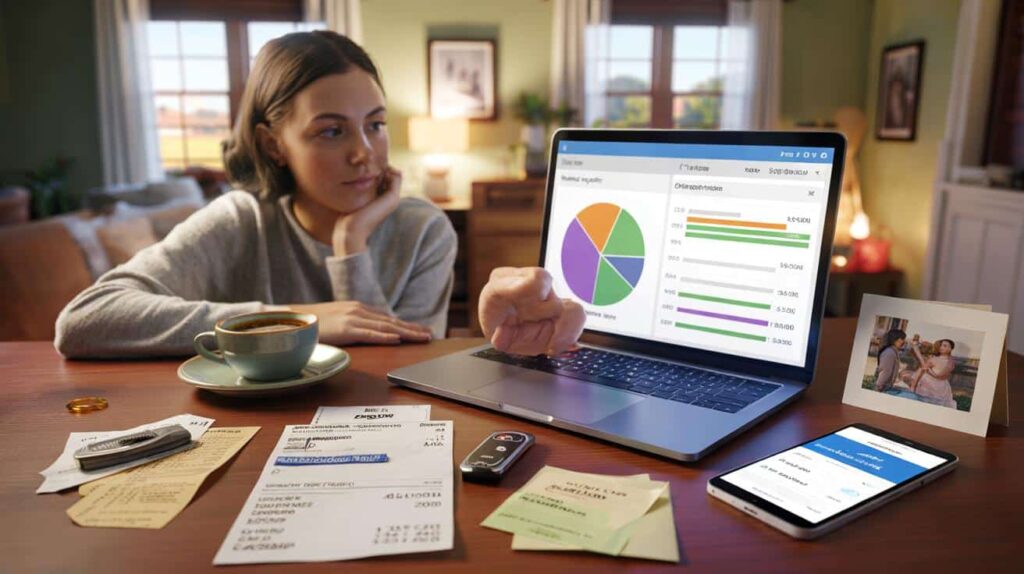
You stare at the numbers and feel that familiar mix of shame and irritation. The budget isn’t wrong, technically. It just doesn’t seem to recognize the way life actually happens.

So you close the file, promise yourself you’ll “start again next month,” and swipe your card anyway.

The real problem isn’t you. It’s the kind of budget you’ve been sold.

When a “perfect” budget collides with a messy life
Spend five minutes on social media and you’ll see those immaculate budget screenshots: every dollar tracked, every category balanced like a museum display. They look calm, controlled, almost smug. Then you compare that to your own week, where a single sick day wipes out your meal plan and your food spending doubles overnight.
There’s a quiet guilt baked into those moments. You start to believe that if you were just more disciplined, the math would magically match the mess. Yet the truth is, most classic budgets are built for a static month that doesn’t exist outside a teacher’s example. Real life bends, stretches, and occasionally explodes. Numbers written once on the first of the month rarely survive contact with reality.
Take Sara, for example. She’s 32, works in marketing, and decided this was The Year of Getting Her Money Together. She picked a popular 50/30/20 budget from a blog, wrote down her categories, downloaded a tracking app, and spent Sunday afternoon entering every recurring bill by hand.
Week one went great. She even felt a bit smug skipping takeout on Tuesday. Then her landlord announced a surprise rent increase starting that same month. At the same time, her best friend got engaged and asked her to be in the wedding. Dress, travel, shower gift. Suddenly, her “fun” category went from mildly strict to laughably unrealistic.
By the end of the month, she was $300 over her set limits. She didn’t quit because she was careless. She quit because the budget refused to move when everything else did.
This is where adaptive budgeting quietly changes the game. Instead of treating your budget like a stone tablet, it treats it like a living document. The point is not to predict every expense perfectly. The point is to create a flexible framework that bends without breaking when life sends surprises.
Think of it like navigation. A rigid budget is an old paper map: helpful until a road is closed. An adaptive budget is GPS. You still choose the destination, but when there’s traffic, it reroutes. You don’t feel like a failure for reshuffling categories mid-month. You feel like a driver who just took a different road. That shift alone can turn budgeting from a guilt machine into a daily tool you actually welcome.
How to build a budget that moves with you
Start with reality, not with goals. Open your banking app and look at the last three months of spending without judgment. Don’t tidy it. Don’t pretend that four food delivery charges in one week were “exceptions.” That mess is your baseline.
Then group that spending into broad, forgiving categories: housing, food, transport, debt, fun, savings. Give each a rough average instead of a strict cap at first. *Your first adaptive budget is not a performance; it’s a photograph.* You’re capturing how money already behaves in your life, so you can gently redirect it instead of trying to bulldoze it overnight.

Next step: build in “elastic” space. One simple way is to add a realistic “Life happens” category—money that’s intentionally unassigned until something unexpected shows up. That’s not sloppy. That’s smart design.
Then, once a week, do a 10–15 minute “budget check-in.” Look at what shifted. Did groceries go up? Did gas drop because you worked from home more? Move money between categories on purpose. Let your budget reflect the week you actually lived, not the one you imagined last Sunday. Let’s be honest: nobody really does this every single day. But once a week is doable, and for most people, that’s enough.
Many people crash not on the math, but on the feelings. They see red numbers and translate them instantly into “I’m bad with money.” That’s harsh, and it’s usually wrong. A flexible budget expects some red. It invites you to ask, calmly, “What changed this week?” instead of “What’s wrong with me?”
“Numbers are neutral. It’s the story we attach to them that decides whether we quit or keep going.”
- Use broad categories so you’re not tracking 37 tiny lines you’ll abandon by week two.
- Have one buffer category that can absorb minor surprises without emotional drama.
- Review weekly, adjust monthly so your plan slowly evolves with your actual life.
- Allow 5–10% of your income as “free spend” so you don’t feel trapped by your own rules.
- Track progress over three months, not three days, so one messy week doesn’t define the story.
Let your money system grow at the same pace as your life
An adaptive budget is less like a diet and more like a relationship. It needs check-ins, small renegotiations, and the occasional apology for pretending you’d never buy coffee again. When your income changes, your season of life shifts, or your priorities move, the numbers should follow. If they don’t, you’re clinging to an identity that no longer fits.
There’s quiet power in saying, “My budget from two years ago doesn’t work for me anymore—and that’s a good sign.” It can mean you moved cities, changed jobs, had a kid, started therapy, or finally began tackling debt. All of those demand new lines, new margins, new breathing room. An old budget that never changes doesn’t prove discipline. It proves denial.
Think back to the last big shift you went through: a breakup, a promotion, a health issue, a new baby. Your time changed, your stress changed, your needs changed. Yet many of us keep dragging around the same rigid structure we built during a totally different chapter.
We’ve all been there, that moment when you look at your carefully drawn “no eating out” rule while stumbling home after a brutal workday, and the rule just feels like another person demanding something from you. That’s when flexible systems quietly win over strict ones. They let you say, without drama, “Okay, this month, eating out goes up a little, savings goes down a little—and that’s a trade I accept.” That kind of honesty is less glamorous than a perfect chart, but it’s the kind of thing people actually sustain.
So maybe the real question isn’t “Why can’t I stick to a budget?” but “What kind of budget would actually stick to me?” One that tracks not just numbers, but patterns. One that remembers your busy seasons, your low-energy weeks, your kid’s school calendar. One that forgives, updates, and keeps going.
A budget that adapts to real life doesn’t promise you’ll never go over on groceries or impulse-buy shoes again. It promises something quieter and more valuable: that you can keep paying attention even when things aren’t perfect. That you don’t need a flawless month to move forward. That you’re allowed to adjust the plan and still call it progress.

The more your money system resembles your actual days—messy, fluctuating, human—the more likely you are to open it, use it, and keep it alive. And that’s when budgeting finally stops being a punishment and starts becoming a tool you can grow with.
| Key point | Detail | Value for the reader |
|---|---|---|
| Start from reality | Use past 3 months of spending as your baseline, without editing | Reduces guilt and builds a plan that reflects real behavior |
| Build in flexibility | Create buffer categories and weekly check-ins | Makes it easier to handle surprises without “quitting” the budget |
| Update with your life | Adjust categories when income, priorities, or seasons change | Keeps the budget relevant, sustainable, and emotionally lighter |
FAQ:
- Question 1How often should I adjust an adaptive budget?
- Question 2What if my income is irregular or freelance?
- Question 3Do I need an app, or can I budget on paper?
- Question 4How do I involve a partner without constant arguments?
- Question 5What if I keep “failing” even with a flexible system?
